Nurture Forward Foundation (NFF)Forward Together, With Care.
Participant safety, dignity, privacy and wellbeing are central to the NFF Global Learning & Cultural Exchange Host Program. NFF maintains policies governing safeguarding, participant conduct, health and emergency response, accommodation, security, privacy, discrimination, incident reporting, photography, transportation, insurance and institutional partnerships.
These policies apply to participants, NFF personnel, host families or accommodation providers, volunteers, relevant local partners and sending organizations involved in the NFF Global Learning & Cultural Exchange Host Program.
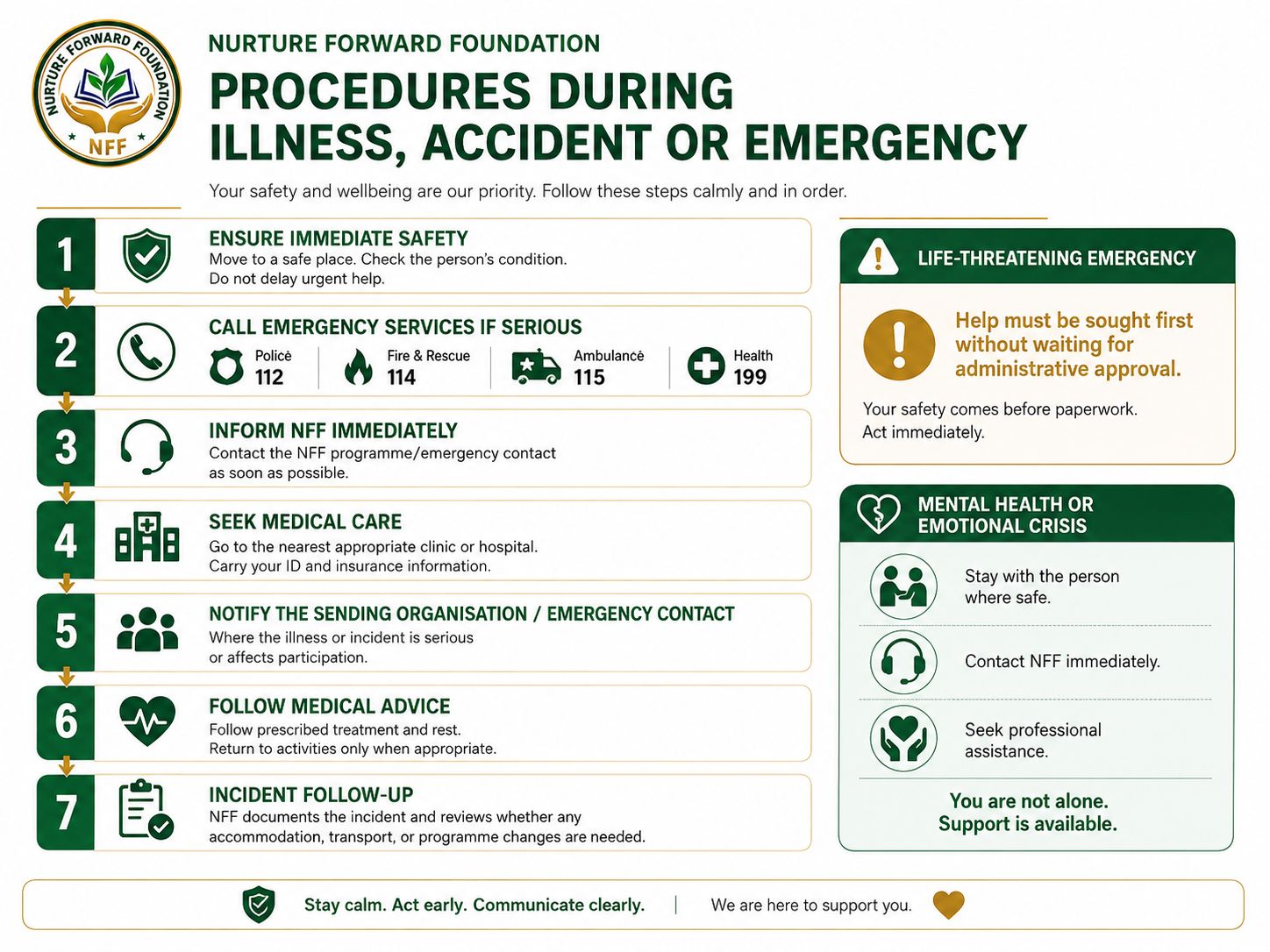
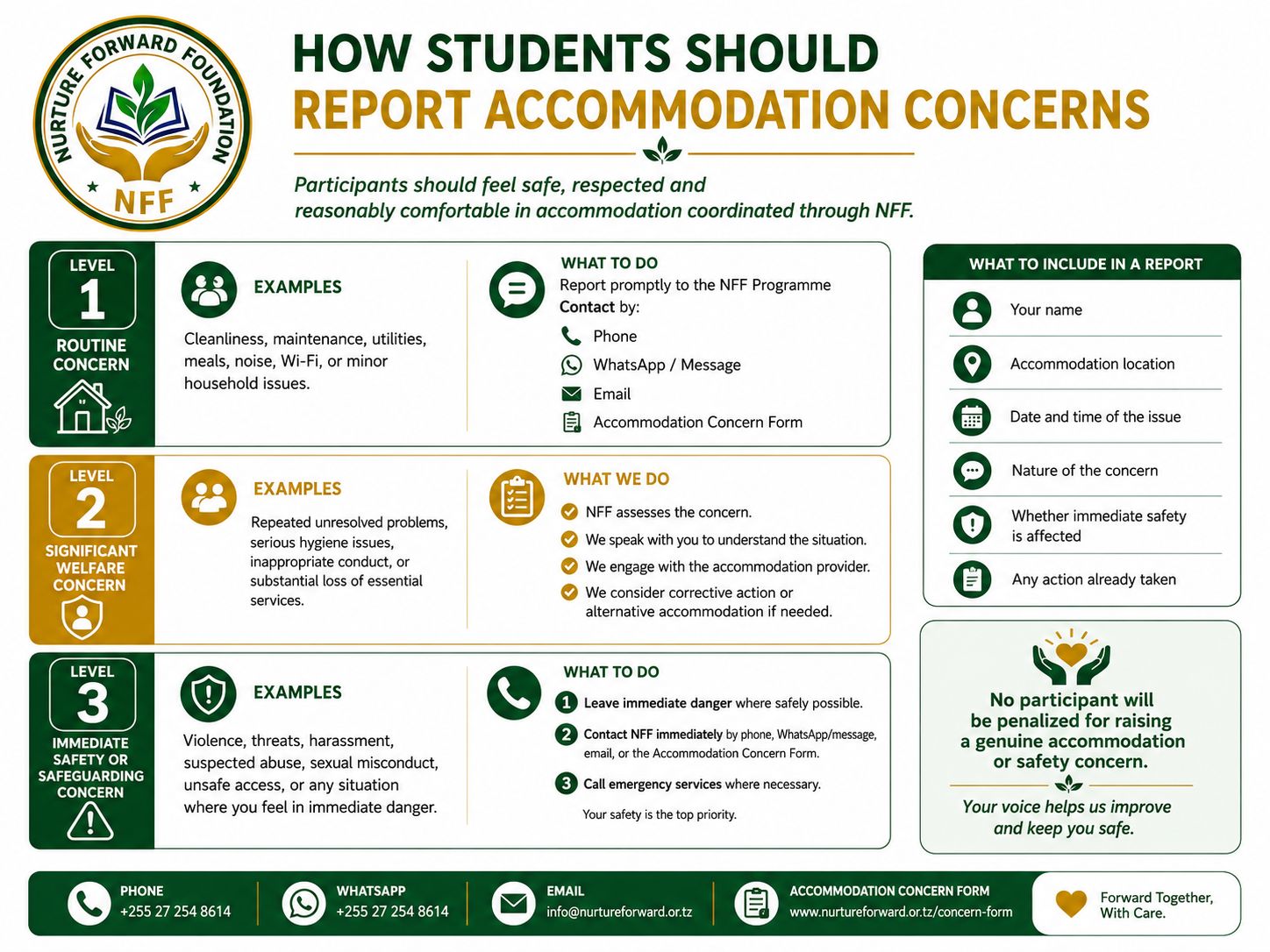
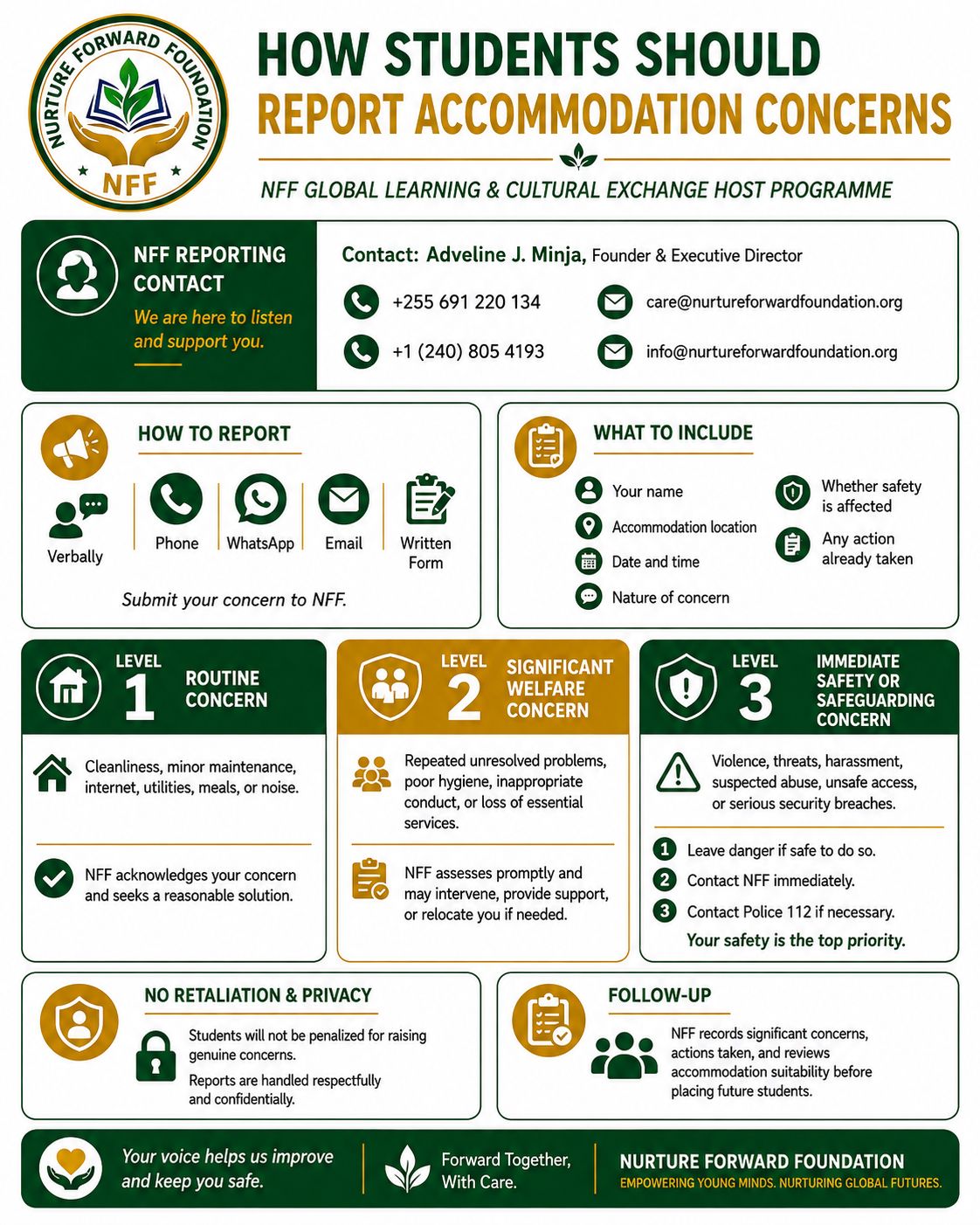
Key guidance for participants, hosts and partners — swipe or use the arrows to browse.
NFF maintains the following policies to protect participant safety, dignity, privacy and wellbeing.
Purpose
Nurture Forward Foundation is committed to protecting every child and young person who participates in, visits, or comes into contact with activities conducted through the NFF Global Learning & Cultural Exchange Host Program.
For program purposes, a child is any participant under the age of 18.
Our Commitment
The safety, dignity, wellbeing and best interests of children shall remain central to all program decisions involving minors.
NFF does not tolerate child abuse, exploitation, neglect, harassment, inappropriate behavior or any other conduct that may place a child at risk.
All persons working directly with minors through the program must maintain appropriate professional and personal boundaries and comply with NFF safeguarding standards.
Safeguarding Requirements
Where minors are hosted, arrangements may include:
· appropriate parental or guardian consent;
· screening of host families or accommodation providers;
· designated supervision arrangements;
· clear emergency contacts;
· age-appropriate orientation;
· safe transportation arrangements;
· agreed rules concerning overnight activities and independent travel;
· appropriate controls concerning photography and social media;
· procedures for reporting suspected abuse, exploitation or neglect.
Children must not be placed in situations that expose them to unnecessary risk.
Reporting Concerns
Any concern about a child’s safety or wellbeing must be reported immediately to the designated NFF safeguarding or program contact.
NFF will assess the concern, take reasonable immediate protective measures, document the matter appropriately and involve the sending organization, parent or guardian, relevant professionals or authorities where required.
Purpose
The Participant Code of Conduct establishes the behavioral standards expected of everyone hosted through the NFF Global Learning & Cultural Exchange Host Program.
Participants Are Expected To
Participants shall:
· respect Tanzanian laws, communities, cultures and traditions;
· treat children, families, professionals, staff, hosts and fellow participants with dignity;
· comply with NFF safeguarding, accommodation, health and safety requirements;
· respect the rules of schools, hospitals, community organizations and other institutions they visit;
· maintain appropriate personal and professional boundaries;
· protect confidential and personal information;
· obtain appropriate permission before photographing, recording or publicly sharing information about other people;
· behave responsibly in accommodation and community settings;
· respect property belonging to hosts, institutions and communities;
· follow reasonable safety and transportation instructions;
· act only within their level of training, qualification and authorization.
Unacceptable Conduct
NFF does not tolerate:
· harassment or bullying;
· discrimination;
· violence or threats;
· sexual misconduct;
· exploitation;
· abuse of children or vulnerable persons;
· theft or deliberate property damage;
· serious breaches of confidentiality;
· professional activity beyond the participant’s authorized scope;
· conduct that seriously endangers the participant or others.
Serious or repeated violations may result in restriction of activities, removal from accommodation or local institutions, notification of the sending organization, or termination of the participant’s NFF hosting arrangement.
Purpose
NFF seeks to provide participants with reasonable local support in protecting their health, safety and wellbeing throughout their stay in Tanzania.
Before Arrival
Participants should provide NFF with appropriate:
· emergency contact information;
· insurance information;
· relevant health or accessibility information;
· travel and arrival details;
· medical information necessary for safe hosting.
Participants are responsible for obtaining appropriate travel and health advice before entering Tanzania.
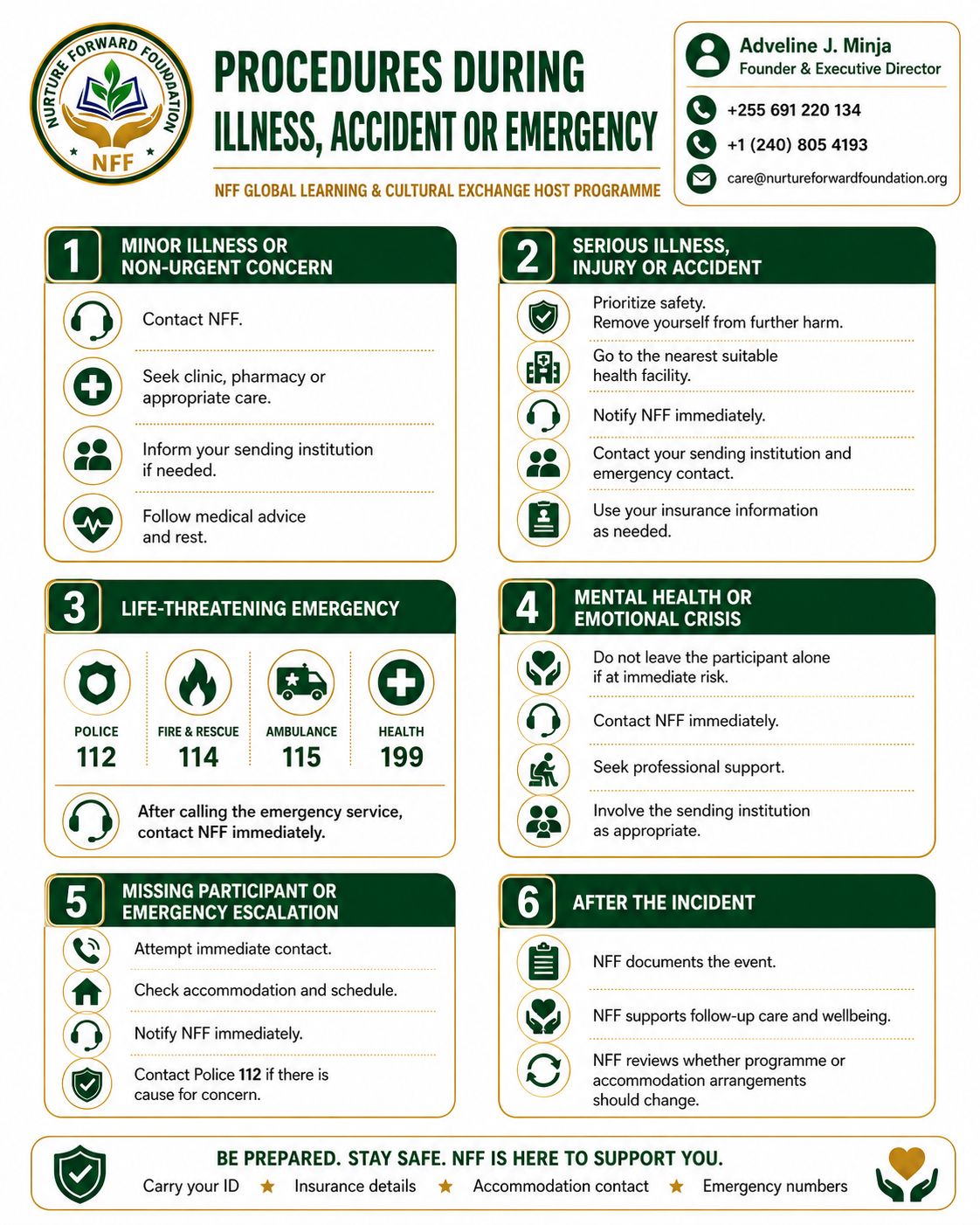
During Illness or Accident
For minor illness or a non-urgent health concern, participants should contact NFF and seek appropriate professional medical assistance where necessary.
Where serious illness or injury occurs, immediate safety and medical attention take priority.
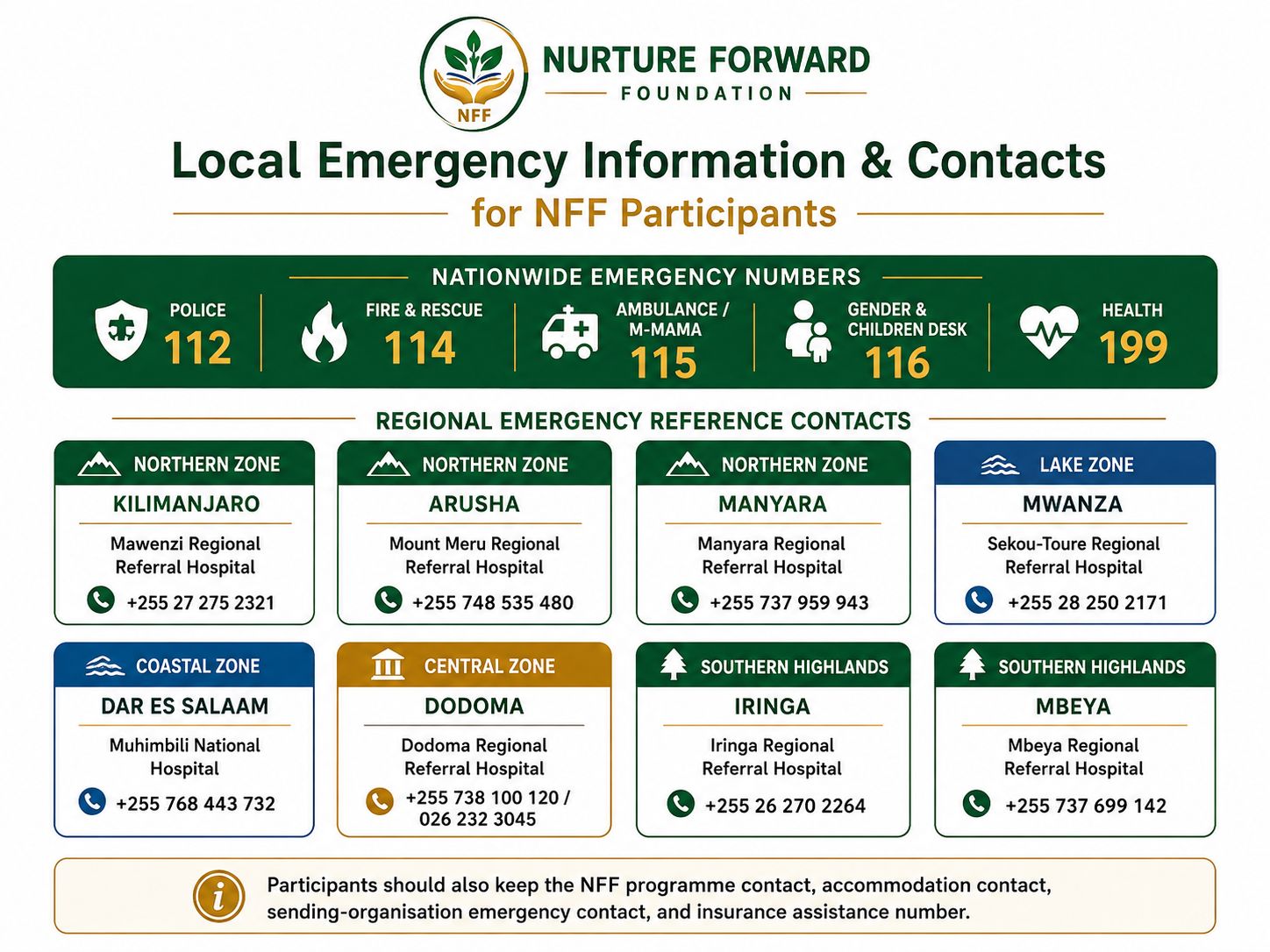
Participants or those assisting them should contact appropriate emergency services or proceed to the nearest suitable medical facility and notify NFF as soon as possible.
Administrative approval should never delay urgent medical assistance.
Emergency Support
NFF may assist with:
· contacting appropriate medical facilities;
· communicating with the sending organization;
· contacting the participant’s emergency contact;
· facilitating communication with the participant’s insurer;
· providing local logistical assistance;
· documenting and following up significant incidents.
NFF does not replace medical professionals, emergency services or insurance providers.
Purpose
NFF seeks to ensure that accommodation coordinated through the programme provides participants with a safe, respectful and reasonably comfortable living environment.
Accommodation Standards
Accommodation should provide reasonable standards of:
· cleanliness and sanitation;
· personal safety and security;
· appropriate sleeping arrangements;
· privacy;
· access to essential facilities;
· safe doors, windows, gates and locks;
· adequate lighting;
· reasonable access to program activities;
· an environment suitable for rest and study.
Host Responsibilities
Hosts or accommodation managers should:
· provide accurate information about the property;
· respect participant privacy and dignity;
· explain relevant household or property rules;
· maintain reasonable safety standards;
· identify responsible persons available to address concerns;
· control inappropriate or unauthorized access to participant areas;
· report serious incidents affecting participant welfare.
Enhanced requirements apply when minors are accommodated.
Reporting Accommodation Concerns
Participants may report concerns verbally, by telephone, WhatsApp, email or an NFF accommodation concern form.
NFF will assess concerns according to their seriousness and may seek corrective action, provide additional support or arrange alternative accommodation where necessary.
No participant should be penalized for raising a genuine accommodation or safety concern.
Purpose
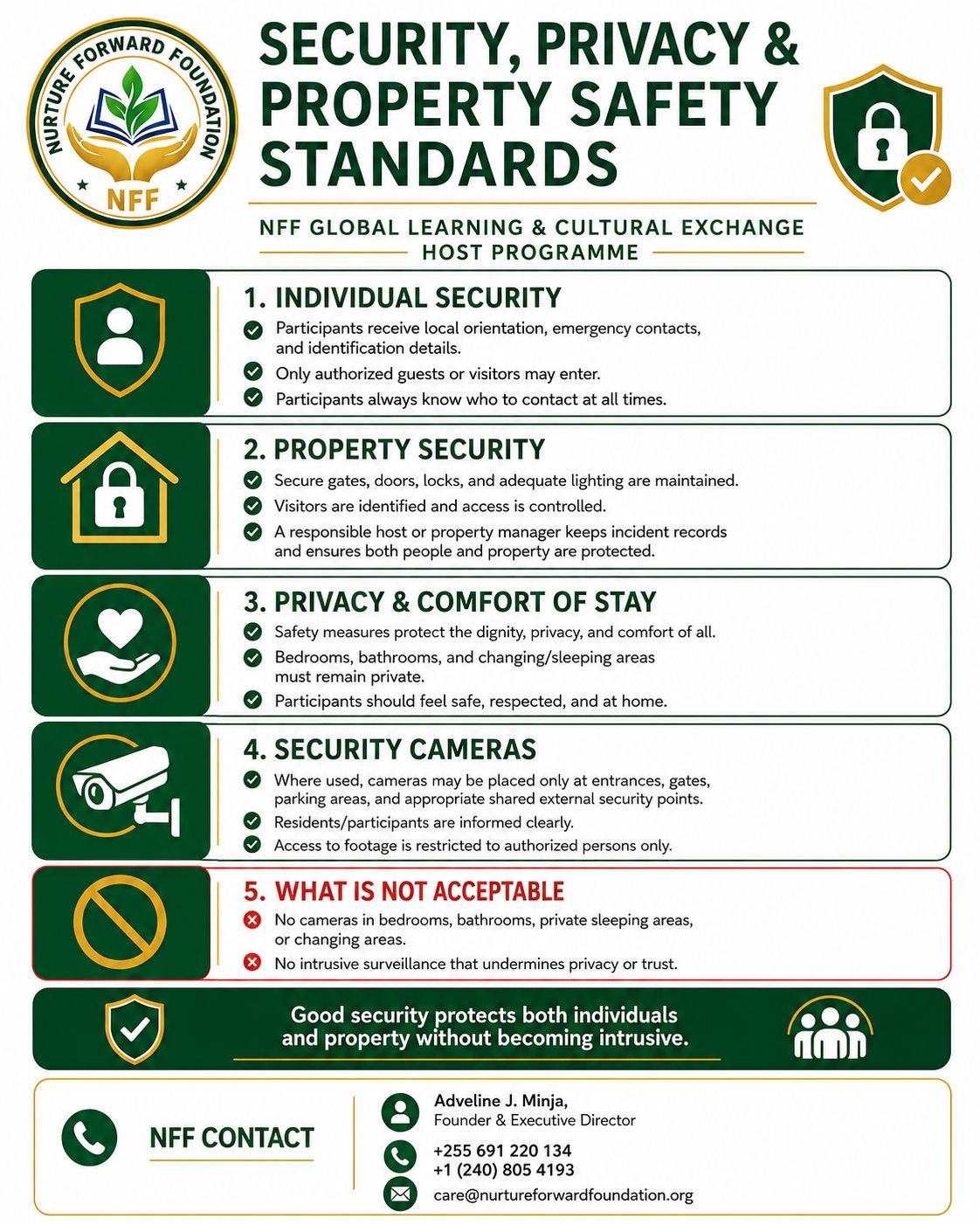
Security arrangements should protect both individuals and property while preserving dignity, comfort and privacy throughout the participant’s stay.
Individual Security
Participants should receive:
· local safety orientation;
· NFF emergency contact information;
· accommodation contact details;
· guidance regarding authorized visitors and access;
· information about local transportation and personal safety;
· clear instructions about whom to contact when concerned.
Property Security
Approved accommodation should maintain reasonable physical security measures such as:
· secure entrances;
· functioning locks;
· controlled gates or access points;
· adequate external lighting;
· responsible property management;
· reasonable visitor identification or access control;
· safe arrangements for important documents and valuables.
Security Cameras
Where security cameras are used, they should serve a genuine safety or property-security purpose.
Cameras may be appropriate at locations such as:
· external entrances and exits;
· gates;
· parking areas;
· driveways;
· other clearly shared security-sensitive areas.
Participants should be informed when CCTV or similar surveillance is operating.
Access to recordings should be restricted to authorized persons and used only for legitimate security, incident-review or lawful purposes.
Privacy
Cameras or intrusive monitoring must not be used in:
· bedrooms;
· bathrooms or toilets;
· showers;
· changing areas;
· private sleeping areas;
· other places where participants reasonably expect privacy.
Security should contribute to a participant feeling safe and comfortable—not watched or intruded upon.
Purpose
NFF recognizes the importance of protecting personal information provided by participants, families, sending organizations and program partners.
Information NFF May Collect
Information may include:
· participant identification and contact details;
· emergency contacts;
· program information;
· travel information;
· accommodation information;
· relevant health or accessibility information;
· safeguarding documentation;
· insurance information;
· incident records where necessary.
How Information Is Used
Personal information shall be used only for legitimate program purposes such as:
· administering hosting arrangements;
· participant communication;
· safeguarding;
· accommodation coordination;
· emergency assistance;
· institutional liaison;
· program monitoring and follow-up.
NFF will not sell participant personal information.
Confidentiality
Access to sensitive information should be limited to persons who reasonably need it for program, safeguarding, emergency, administrative or lawful purposes.
Information concerning children, health matters, safeguarding incidents and personal circumstances requires additional care.
Commitment
NFF seeks to provide a respectful and inclusive hosting environment in which participants, staff, hosts, partners and community members are treated with dignity.
Harassment, bullying, intimidation, exploitation or degrading treatment will not be tolerated.
NFF does not accept unfair discrimination on grounds such as:
· gender;
· age;
· disability;
· nationality;
· race or ethnicity;
· religion;
· socioeconomic background;
· or other personal characteristics protected under applicable standards or law.
Participants are expected to respect cultural, linguistic, social and personal differences.
Reporting
Concerns may be reported to the designated NFF program contact.
Reports will be considered seriously and handled with appropriate confidentiality.
Retaliation against anyone raising a genuine concern is prohibited.
Purpose
Significant incidents affecting participant safety, welfare, safeguarding, accommodation or program conduct must be reported promptly.
Incidents May Include
· serious illness or injury;
· accident;
· safeguarding concern;
· harassment or discrimination;
· missing participant;
· transportation incident;
· serious security concern;
· theft;
· accommodation emergency;
· serious misconduct;
· professional or institutional incident.
NFF Response
Depending on the nature of the incident, NFF may:
· protect the participant from immediate danger;
· contact emergency services;
· obtain medical assistance;
· notify the sending organization;
· contact a parent or guardian where appropriate;
· communicate with insurers;
· inform a relevant local institution;
· arrange relocation;
· document the incident;
· review corrective action.
Incident information shall be shared only with persons who reasonably need it to respond appropriately.
Purpose
NFF promotes respectful communication and protects the dignity and privacy of people encountered through program activities.
Participants must not assume that access to a community, institution or individual automatically gives permission to photograph, record or publish information about them.
Consent Requirements
Appropriate permission should be obtained before identifiable:
· photographs;
· videos;
· interviews;
· testimonials;
· personal stories;
· other recordings
are collected or publicly shared.
Additional caution applies when photographing or recording:
· children;
· patients;
· vulnerable individuals;
· schools;
· healthcare facilities;
· private homes;
· sensitive community situations.
Participants must also comply with the media and confidentiality rules of local partner institutions.
NFF shall seek appropriate consent before using identifiable participant photographs or testimonials in organizational communications.
Purpose
Transportation coordinated through the program should support safe and reliable movement of participants.
NFF Transportation Standards
Where NFF coordinates transportation, arrangements should consider:
· safety;
· reliability;
· suitability for the number and age of participants;
· condition and appropriateness of vehicles;
· responsible drivers or providers;
· route and travel conditions;
· safeguarding requirements for minors.
Participants should follow agreed transportation arrangements and notify NFF of significant changes.
Additional supervision or consent requirements may apply to minors.
Personal and Optional Travel
Participants undertaking personal travel outside program arrangements remain responsible for following appropriate safety guidance and informing NFF where their absence affects program or accommodation arrangements.
Optional tourism and safari services are separate from NFF’s hosting function and should be provided through appropriate tourism providers.
Purpose
Appropriate insurance protects participants and program partners from avoidable financial and medical risk.
Participants must maintain suitable insurance for the duration of their international travel and program participation.
Depending on the program this may include:
· international medical insurance;
· emergency medical evacuation;
· travel insurance;
· personal accident insurance;
· professional or malpractice coverage where applicable;
· trip cancellation or interruption protection.
NFF may require proof of insurance before arrival.
NFF local hosting support does not replace the participant’s insurance and does not assume responsibility for expenses normally covered by an insurer.
Purpose
Clear responsibilities between NFF, sending organizations and local partner institutions are essential for participant safety and program quality.
Formal partnerships should be supported by an appropriate written agreement or Memorandum of Understanding.
NFF Responsibilities
NFF may be responsible for:
· local hosting and coordination;
· pre-arrival information;
· accommodation coordination;
· orientation;
· participant welfare;
· local cultural and community engagement;
· local transportation support;
· emergency coordination;
· institutional liaison;
· safeguarding oversight within its hosting role;
· program follow-up.
Sending Organizations Responsibilities
The sending organizations may retain responsibility for:
· participant recruitment and selection;
· academic or educational program design;
· academic supervision and assessment;
· academic credit or certification;
· participant eligibility;
· international travel;
· insurance;
· pre-departure preparation;
· professional requirements;
· disciplinary support;
· parental or guardian requirements where minors are involved.
Local Specialist Institution Responsibilities
Hospitals, schools, universities, community’s organizations or other specialist institutions determine activities participants may undertake within their facilities and maintain responsibility for professional or institutional supervision within their mandate.
Shared Responsibility
All parties should communicate clearly, respect safeguarding obligations and avoid assuming responsibilities belonging to another organizations unless specifically agreed in writing.
Students and or all participants will be provided with and carry the actual NFF emergency contact details directly. Contact NFF immediately for urgent program/safeguarding/accommodation matters.
Adveline J. Minja
Founder & Executive Director